
Wine Snobbery revisited
A look at one of the most controversial wine books ever published, Andrew Barr’s ‘Wine Snobbery’. Plus a plug for new podcast episodes and the Faversham Literary Festival.

Before we kick off, a couple of plugs.
First, new episodes of Intoxicating History are here including one on Winston Churchill in which I do an eerily convincing impersonation of the great man himself. And Tom and I are on Youtube so you can see us as well as hear us. What a fascinating modern age we live in.
Second, I’m going to be chairing a few events at the Faversham Literary Festival this month with some of my favourite authors: my podcast co-host Tom Parker Bowles (24 February 2pm); the wine wanker himself Tom Gilbey (25 February 5pm); Britain’s beer sage Pete Brown (20 February 6pm); and Stephen Harris (1 March 5pm), local boy turned Michelin-starred chef at the Sportsman. All four are hugely entertaining so I won’t have to do much. Faversham is just over an hour from London and it’s a lovely town, crammed with pubs. Well worth a visit.
Right now a review of a favourite wine book…
Andrew Barr’s Wine Snobbery upset a lot of people when it came out in 1988. Serena Sutcliffe MW threatened legal action over Barr's observation that she recommended wines she imported without declaring an interest. She wasn’t the only one upset: Robert Parker, Jane MacQuitty, Charles Metcalf and other writers were all taken to task. Yet Parker, to his credit, is quoted on the jacket calling it ‘one of the most important wine books written in the last decade.’
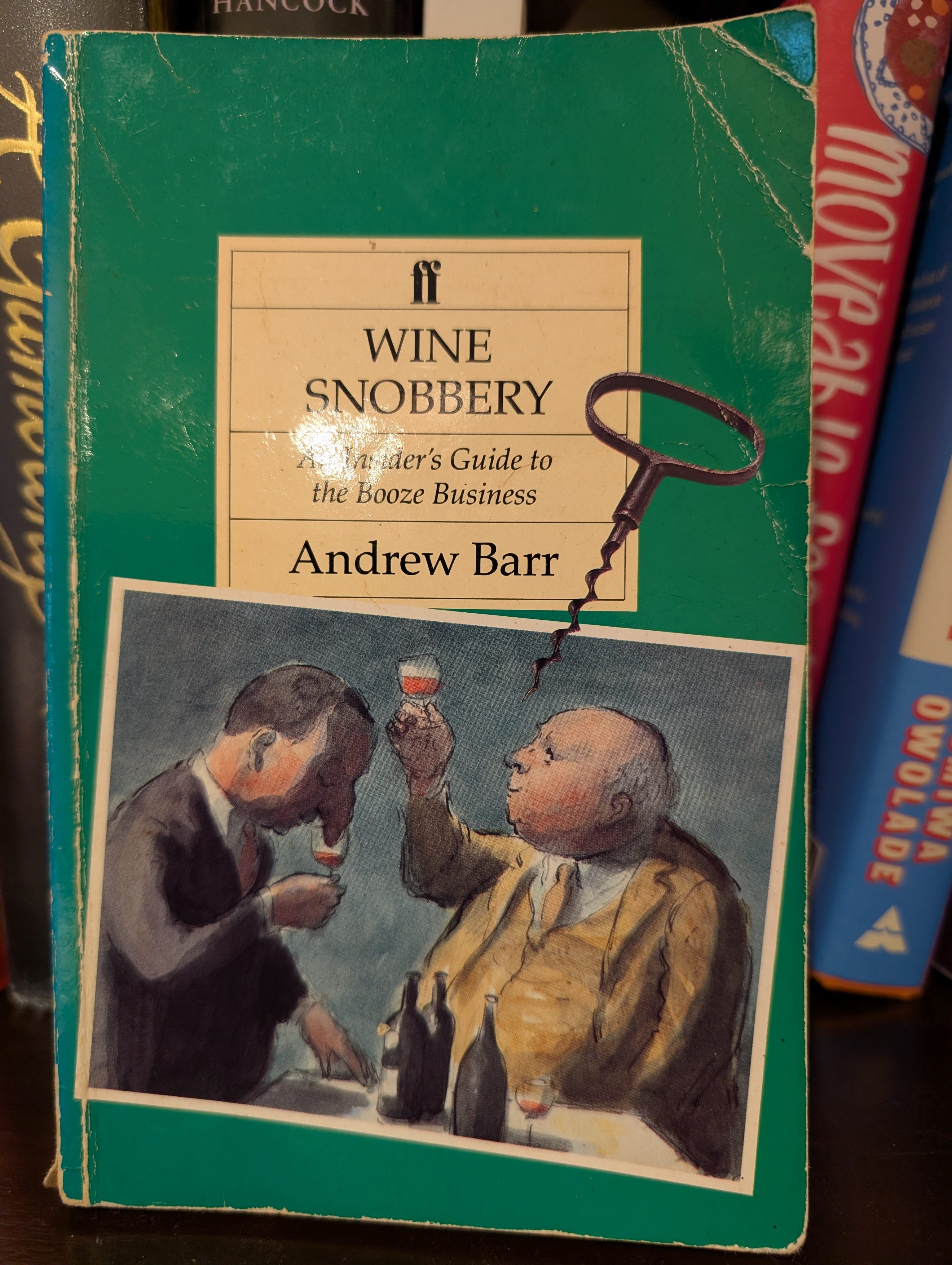
Its author was a brilliant and provocative wine writer who flourished in the 1980s and 1990s before disappearing from sight only to reappear earlier this year with an interview with Anthony Rose in the Drinks Business. He’s also on Substack now. Unlike most British wine writers Barr didn’t come up through the trade or the drinks press. Instead he started first at Time Out followed by a regular gig at the British edition of Vogue magazine. This gave Barr an outsider’s perspective on the wine industry which he expanded on in a series of books Pinot Noir (1992), Drink: A Social History (1995) and Drink: A Social History of America (1999). These are books I have turned to time and time again for reference and stimulation. As I am currently researching my own work on wine and class (due for publication in 2027) I thought it was time to revisit Barr’s debut.
Wine Snobbery was published in 1988, a time when the British and Americans were taking to wine in a way they had never done before. In 1960 the British drank one litre of wine a year per capita; in 1985 it was ten, according to Barr. But the industry was rocked by a series of adulteration revelations which came to a head with the so-called ‘anti-freeze’ scandal in the mid 1980s, when millions of gallons of Austrian wine were found to have been sweetened with diethylene glycol, a toxic solvent used in liquids such as brake fluid and antifreeze. Much of this Austrian wine was used to bolster German wine which was incredibly popular at the time.
Barr uses the concept of wine snobbery as a jumping off point to peer behind the curtain of the business. His premise is that wine’s elevated status allowed the entire business from vineyard to retailer to take advantage of all these eager but ignorant new customers. He writes: “it is the purpose of this book to illuminate those dubious practices which are normally exposed by occasional wine scandals.”
Despite being only 27 when it came out, Barr writes with an intimidating authority. So much so that I was reminded of Lord Melbourne, Queen Victoria’s first prime minister, on the historian Macaulay: ‘I wish I was as cocksure of anything as Tom Macaulay is of everything.’
