
Drinking in P.G. Wodehouse
'Stiffish, Jeeves. Not too much soda, but splash the brandy about a bit.'

One of the first books I bought my wife when she moved to England from California was a P.G. Wodehouse anthology. Happily she found it as funny as I did, or our nascent marriage may well have been in trouble. Can you imagine spending the rest of your life with someone who didn’t crack a smile at Right Ho, Jeeves?
In particular she loved the brilliant descriptions of hangovers, such as “the cat stamped into the room” or “the roar of the butterflies.” There really is a lot of drinking in the world of Bertie Wooster and, consequently, an awful lot of hangovers. In his 1949 Jeeves and Wooster novel The Mating Season, Wodehouse outlines six distinct types of hangover: “the Broken Compass, the Sewing Machine, the Comet, the Atomic, the Cement Mixer and the Gremlin Boogie.” One can imagine what they do to you just from the names. The Cement Mixer has to be my personal worst.
Wodehouse is wonderfully inventive with the language of drunkenness. This is from the short story collection Meet Mr Mulliner:
“Intoxicated? The word did not express it by a mile. He was oiled, boiled, fried, plastered, whiffled, sozzled, and blotto.”
Mulliner frequents a pub called the Angler’s Rest where all the regulars are named after their faovurite drinks such as Gin-and-Ginger-Ale, Small Bass and Double-Whisky-and-Splash. Mulliner himself is partial to a hot Scotch and lemon.
Many of the most famous moments in Wodehouse are alcohol-driven. Most famously there’s Gussie Fink-Nottle in Right Ho, Jeeves, who drinks orange juice spiked with gin before delivering a disastrous address to the pupils and staff of Market Snodsbury Grammar School. Many of the intricate plots involve making amends for scrapes got into while under the influence. Think of the nominally teetotal Motty, foisted on Bertie in New York by his mother Lady Malvern, a friend of the formidable Aunt Agatha’s, in the short story “Jeeves and the Unbidden Guest.” Once his mother has departed, young Motty goes on a tremendous bender, at one point requiring Jeeves to administer one of his famous hangover cures to the previously comatose young man.
Ah, Jeeves’s hangover cures! In Jeeves Takes Charge, the remedy is described as follows:
“It is a little preparation of my own invention. It is the Worcester Sauce that gives it its colour. The raw egg makes it nutritious. The red pepper gives it its bite. Gentlemen have told me they have found it extremely invigorating after a late evening.”
The results are, according to Bertie, dramatic:
“For perhaps the split part of a second nothing happens. It is as though all Nature waited breathless. Then, suddenly, it is as if the Last Trump had sounded and Judgement Day set in with unusual severity.”
And later:
“I felt as though somebody had touched off a bomb inside the old bean and was strolling down my throat with a lighted torch, and then everything seemed suddenly to get all right. The sun shone in through the window; birds twittered in the tree-tops; and, generally speaking, hope dawned once more.”
This piece is, I confess, mainly an excuse to quote Wodehouse — the most quotable writer in the English language after Shakespeare (and I suppose the King James Bible). What would Bertie have been drinking the night before to necessitate such a severe remedy?
Bertie is rarely the worst-behaved character in Wodehouse’s novels and actually claimed to be a very moderate drinker. In The Code of the Woosters he says:
“Except at times of special revelry, I am exceedingly moderate in my potations. A brace of cocktails, a glass of wine at dinner and possibly a liqueur with the coffee — that is Bertram Wooster.”
He does, however, love champagne and is inordinately fond of a brandy and soda, the drink of choice for the upper classes, known among the Bright Young Things as a “B&S.” The only person I knew partial to one was my grandfather, though it’s hard to picture him as a Bright Young Thing — even if he did once win a Charleston competition. There’s a wonderful B&S exchange in The Inimitable Jeeves:
“’I say, Jeeves,’ I said.
‘Sir?’
‘Mix me a stiffish brandy and soda.’
‘Yes, sir.’
‘Stiffish, Jeeves. Not too much soda, but splash the brandy about a bit.’
‘Very good, sir.’”
Wooster was, as I noted a couple of weeks ago, part of the post-First World War cocktail generation. There’s even a novel called Cocktail Time, published in 1958. He spends much of his time at the Drones Club, modelled on Buck’s, which was founded in 1919 by Captain Herbert Buckmaster to provide a place for young people to drink the new American-style cocktails that were sweeping fashionable London. As Sandbrook and Syrett explain on their excellent Wodehouse Book Club podcast, Wooster inhabits a sort of Anglo-American fantasy world. American magazines paid considerably more than British ones, so Wodehouse cannily kept sending Bertie across the Atlantic for adventures and scrapes.
As you’d expect in such a world, the dry martini features heavily. The most famous Wodehouse line on the subject is: “He was white and shaken, like a dry martini” — which is interesting, as it suggests martinis were routinely shaken in that era. Perhaps Ian Fleming wasn’t so wide of the mark with Bond’s famous preference after all.
But there are also more exotic drinks on offer. In the 1924 story “The Rummy Affair of Old Biffy,” Wooster visits a bar at Wembley and encounters a drink called a Green Swizzle:
“A planter, apparently, does not consider he has had a drink unless it contains at least seven ingredients, and I’m not saying, mind you, that he isn’t right. The man behind the bar told us the things were called Green Swizzles; and, if ever I marry and have a son, Green Swizzle Wooster is the name that will go down in the register.”
The Green Swizzle is a real cocktail of Caribbean origin, and there’s some enjoyable debate about what gives it its colour — crème de menthe and Green Chartreuse are the main contenders. There’s a recipe worth investigating at summitsips.com if you’re minded to experiment.
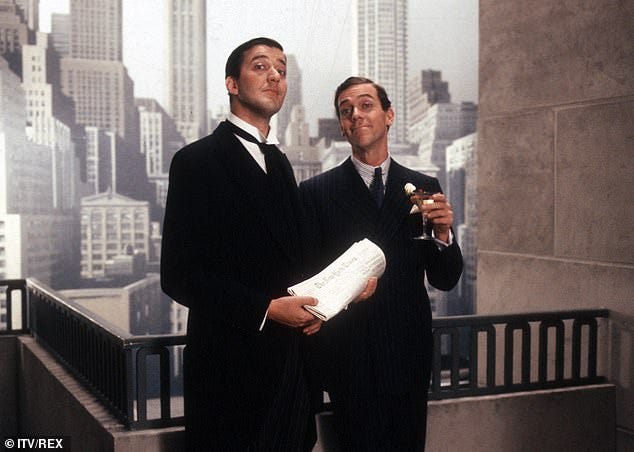
Jeeves, by contrast, is more of a port and cigar man. He is a member of the Junior Ganymede, a private club for valets in Curzon Street, Mayfair, where gentlemen’s gentlemen exchange confidential intelligence about the antics of their employers, all dutifully recorded in the notorious “Club Book.” In The Code of the Woosters, Jeeves is said to possess “a voice as dignified as tawny port” - something that Stephen Fry captures beautifully in the old ITV series from the 1990s.
Port features throughout the Wodehouse novels. The butler Beach at Blandings Castle is an enormous enthusiast. And as Ukridge observes in “Success Story” from Nothing Serious (1950): “It has frequently happened that a good go at the port at a critical moment has made all the difference to me as a thinking force. The stuff seems to act directly on the little grey cells, causing them to flex their muscles and chuck their chests out.” Precisely my own experience over the festive period, right ho, Jeeves!
I was informed shortly after publishing this that there’s a compendium of Wodehouse wisdom on alcohol called 'Highballs for Breakfast’ which would have made writing this much easier. I have just ordered a copy.
Well done! Any excuse to quote Wodehouse on drink, or anything really, is most welcome.
I've never tried brandy and soda before, but I've also never read any Wodehouse. I must rectify both situations. I do like a brandy (cognac) with lemonade though, or with babycham at Christmas.