
Alcohol is civilisation
“We should not fail to notice the conspicuous absence of kimchi-or-yoghurt-based super-cultures.”

I subscribe to a drinks industry mailing list with a round-up of the previous day’s booze news. As you can imagine it makes depressing reading for someone who writes about wine for a living. In the last week, there were stories about vineyards in California ripping up their vines because nobody wants the grapes, endless ‘why won’t Gen Z drink’ articles and a story about a fellow wine writer who was denied treatment in a hospital because he was “using alcohol”.
The last story is particularly worrying as it used to be that the definition of an alcoholic was someone who drinks more than their physician. But the young doctor’s attitude is simply in line with a new puritan approach to alcohol on both sides of the Atlantic. The journalist Felicity Carter has covered in detail the various well-funded groups, often with links to Methodist organisations who have been involved in temperance campaigns since the nineteenth century, are attempting to “denormalise” alcohol. The WHO (World Health Organisation) has said that there’s no safe level of alcohol consumption, a view that is increasingly parroted in papers like The New York Times. The stock price of drinks giant Diageo, once one of the most solid investments around, has plunged dramatically in recent years. Ireland - Ireland! - is planning to put cigarette-style health warnings on bottles. Increasingly alcohol is being treated like smoking. The difference is that tobacco is a habit roughly four centuries old whereas, in the words of Roger Scruton: “you could say that wine is probably as old as civilisation; I prefer to say that it is civilisation...”
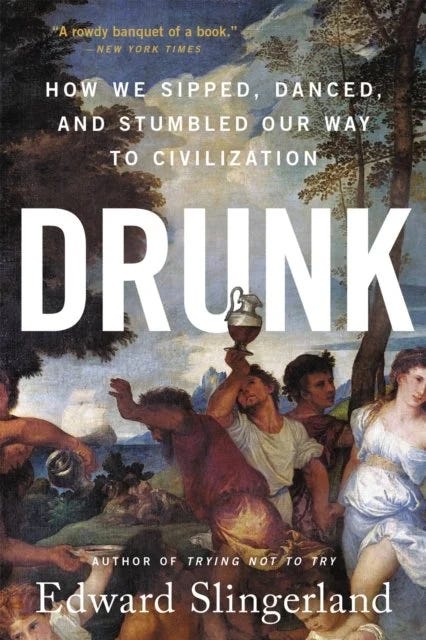
Edward Slingerland would agree. In his hugely entertaining book Drunk: How We Sipped, Danced, and Stumbled Our Way to Civilization, he argues that we didn’t start brewing because of agriculture but rather farming developed to aid production of beer. Agriculture, towns, laws and government all came together in order that man could secure a regular supply of drink, be it wine, beer or cider. Cities formed when people got together to drink. He drily notes: “We should not fail to notice the conspicuous absence of kimchi-or-yoghurt-based super-cultures.”
Alcohol helped with social cohesion. Once early humans began living in settlements far larger than anything their genetics had prepared them for, they needed a way to get along with strangers. Alcohol provided it. “There are many ways humans can achieve a hive mind,” Slingerland writes, “but liquor is certainly the quickest.” Its primary social purpose, he argues, was getting “a selfish, suspicious, narrowly goal-orientated primate to loosen up and connect with strangers.”
Western Civilisation, Europe and its off-shoots, is particularly boozy with its classical and Biblical foundations. After all, Jesus’s first miracle was turning water into wine at the wedding at Cana. And not just any old plonk but noticeably good wine. Proverbs says: “Give strong drink unto him that is ready to perish, and wine unto them that be of heavy hearts. Let him drink, and forget poverty, and remember his misery no more.” The Old and New testaments despite what some Southern Baptists have tried to prove are very clear on the subject: drink is good but drunkenness is, usually, bad. Though not always. Judaism has Purim, a holiday that celebrates Queen Esther who saved them from annihilation in ancient Persia. During festivities, Jews are enjoined to drink so much that they can’t tell the difference between “”cursed is Haman” and “blessed is Mordechai”.
In Christian countries saints days’ have long provided occasions for ritualised drunkenness. La Nit de Sant Joan in June is the one night when everyone in Catalonia gets Saturday-night-in-a-British-market-city drunk. The Festa São João in Oporto serves a similar function. In protestant countries these days of officially sanctioned drunkenness are usually secular or even slightly pagan. Faversham, the town where I live, has a two day hop festival where people where crowns of hops and it’s quite acceptable to drink beer at ten in the morning.
Our classical inheritance too is steeped in wine. Greece and Rome were cultures that venerated the grape in the form of Dionysus and Bacchus. These gods acknowledged alcohol’s destructive side as well as its pleasures. There was a Dionysian cult where participants known as maenads, mad women, would take part in wine-fuelled rites where they would experience ‘enthusiasm’, literally to be filled with the god, and ‘ecstasy’, to stand outside oneself. Orpheus the bard and companion of Jason of Golden Fleece fame met a horrible demise when he was torn to pieces by the Dionysus-worshipping Ciconian women. ‘Women, know limits!’ as Harry Enfield used to say.
It was a sign of manliness for the ancient Greeks if you could, like Socrates, keep your wits about you in your cups. Plato wrote that “truth is revealed by wine and children”. Or as the Romans put it, In Vino Veritas. Alcohol is a way to bond with people and also to see how people handle themselves after a few too many. If someone starts telling you that the Jews were behind 9/11 as one former friend did late one night, then it’s time to end the friendship.
Western literature is almost inconceivable without alcohol. There are, of course, the famous heavy drinkers: F. Scott Fitzgerald, Arthur Rimbaud or Jean Rhys. But alcohol is everywhere in literature from ancient Greece to 21st century New York, lurking in the background, fuelling conversation, filling in the gaps, facilitating sex and, yes, sometimes wreaking havoc. It’s there in the cinema, in music and painters like Titian or Breughal the Elder. European civilisation is inseparable from the consumption of wine, beer and whisky. Today, look at the dearth of creativity in film publishing or popular music, you can blame smart phones and tech companies but a lack of alcohol-fuelled sociability surely plays its part too. The writer Roger Lewis said, “ever since sparkling water came in and boozy publishers’ lunches got the heave-ho there has been no actual improvement in English literature.”
Alcohol has long been the eternal icebreaker, something that keeps boredom at bay and makes reality bearable. As other forms of entertainment were developed, however, the Western need and desire for alcoholic intoxication has declined. JB Priestly, in his An English Journey written in the 1930s, notices how the rise of cinema, jazz music and radio has led to a decline in pub-going. A similar thing happened in the 1970s with the development of central heating and colour television. You can see the shift in What Ever Happened to the Likely Lads where Bob (Rodney Bewes) moves into suburban heaven with his wife while Terry (James Bolam) sticks with the pub.
Slingerland describes it as “the gradual replacement of collective bonding with passive, isolated individualism.” Now something has come along that makes the power of television, radio and cinema seem negligible, the smart phone. Now there’s a device to keep you amused from the moment you wake up until bedtime. Some very clever people have invested billions in making it irresistible. Man wasn’t built for so much stimulation but at least it keeps people occupied so that they don’t notice how our infrastructure and society are falling apart.
One gets the feeling that the current British government would rather have its citizens as passive consumers rather than complaining at public houses, places of sedition from the Restoration coffee houses to the trade union movement. The sector has been hit particularly hard by rising energy costs, minimum wage, national insurance and with the looming ‘banter laws’ which makes landlords responsible if people in the pub feel threatened by anything said in their establishment. There is a suspicion of pubs as places with anti-establishment rhetoric that are beyond policing. Increasingly people are drinking on their own, the most dangerous way to do it.
The state sees alcohol purely a cost to the health service or a drag on productivity, rather than an intrinsic part of society. The attitude of the doctor my wine colleague encountered is on the rise but as with the rise in popular forms of entertainment this has a longer history than you might think. The Spanish philosopher José Ortega y Gasset (1883-1955) wrote: “Once, long before wine became an administrative problem, Bacchus was a god, wine was divine… Yet our solution is symptomatic of the dullness of our age, its administrative hypertrophy, its morbidly cautious preoccupation with today’s trivia and tomorrow’s problems, and its total lack of heroic spirit.” For those generations who were fortunate enough to grow up in the (relative) peace of the West after World War Two, alcohol (and other drugs) provide, along with organised sport, an opportunity for camaraderie and bonding - something that is also on the decline now.
When people do go out, they are drinking less or not at all. The rapid spread of GLP-1 weight-loss drugs such as Ozempic and Mounjaro, announced by the parade of suddenly, implausibly thin celebrities, is reshaping consumption habits in ways the drinks industry has not yet begun to reckon with. If I were running a restaurant, I would be deeply anxious. These drugs suppress appetite and dampen the desire for alcohol; their uptake among high earners, precisely the demographic that drinks the most expensively, should be alarming to anyone in the trade. The increase in use of other drugs has also had an impact on alcohol consumption. Particularly in America, many drinkers have switched to cannabis which is now legal in most states.
Having a large percentage of Muslims has also affected alcohol consumption particularly in Europe. Of course, not all Muslims are totally abstinent and indeed the Islamic world has its own rich drinking culture with poets like Abu Nuwas and Omar Khayyam but you can’t ignore the significance of the demographic changes. Though some try. I recently read a book about the decline of East End pubs which didn’t mention once the fact that Whitechapel is forty per cent Muslim might have something to do with why there are so few pubs left.
Then there is the most troubling trend of all. Birth rates across the Western world have fallen off a cliff. Alcohol has always been, among other things, a social lubricant for reproduction, so to speak, loosening inhibition, shortening the distance between strangers, making the terrifying business of intimacy, at least for the English, more manageable. As drinking has declined, pornography consumption has exploded and people are losing that capacity for messy business of good old-fashioned in-person sex.
So much of human creativity, sex and culture has for centuries been marinated in alcohol. What’s going to happen if that stops? It will be a very different world. Perhaps a safer world but certainly a duller one: after work drinks with all the social and sexual possibilities replaced with Google hangouts. We need to get out of our houses, into the pubs and bars to talk, flirt and procreate. A civilisation that is open to new ideas, and culturally lively is made possible by constant human interaction which in the West at least has always been facilitated by alcohol. Civilisation will go on if we continue down the path to sobriety, it just won’t be a lot of fun.
A shorter version of this article appeared in Engelsberg Ideas.
Sigh… this unfortunately lines up with my own anecdotal experience. I’m part of a small group of young adults from my Evangelical church. The millennial (27-37ish) members enjoy our craft beers and have strong opinions on what red wine or type of whiskey we prefer. The younger members celebrate their 21st birthdays with “mock-tails”. I recently told one of them that I feel the same way about mock-tails as I do about plant based meat substitutes. It might taste fine, it’s just… kinda sad.
Permit me to suggest, as a professional bartender, that the stories of younger generations eschewing alcohol are… exaggerated. And by “exaggerated” I mean “horseshit”. The big liquor companies like Brown-Forman and Diageo have been using this line as an excuse for their own failures, but it’s more and more apparent that they’re the ones responsible for their own shortcomings. Drink categories like spritzes and RTD cocktails are on the rise. Booze ain’t going anywhere, but tastes change.